

AI is no longer a technology discussion, – it’s a leadership discussion.
Over the past two years, we’ve seen organisations move from asking “Should we adopt AI?” to “How do we govern it responsibly?”
For many C-suite leaders, the challenge is no longer access to AI tools. It’s creating clarity.
Employees are increasingly using AI to improve productivity, yet many organisations still lack clear governance around what information can be shared, which platforms are approved, how outputs should be verified, and where human judgement must remain the final decision-maker.
➡️ This creates an uncomfortable grey area. ⬅️
Teams want to innovate. Leaders want to protect intellectual property, customer data, regulatory compliance, and organisational reputation. Both objectives are valid, – but without clear policies, they can easily come into conflict.
Effective AI governance isn’t about limiting innovation. It’s about creating confidence.
The organisations that will benefit most from AI are unlikely to be those with the greatest number of licences. They will be those with leadership teams that establish clear principles, encourage responsible experimentation, invest in AI literacy, and define accountability at every level of the business.
As executive search professionals, we’re already seeing a shift in the leadership capabilities organisations value. Beyond technical expertise, boards are increasingly looking for executives who can lead through technological change, – and challenge – balance innovation with governance, and make sound strategic decisions in an evolving landscape.
The AI revolution isn’t replacing leadership, – it is redefining what great leadership looks like.
I’m interested to hear from CEOs, Board Directors, CTOs, CIOs and business leaders. How has AI changed the conversations taking place in your executive team, and what governance challenges have you encountered as adoption has accelerated?
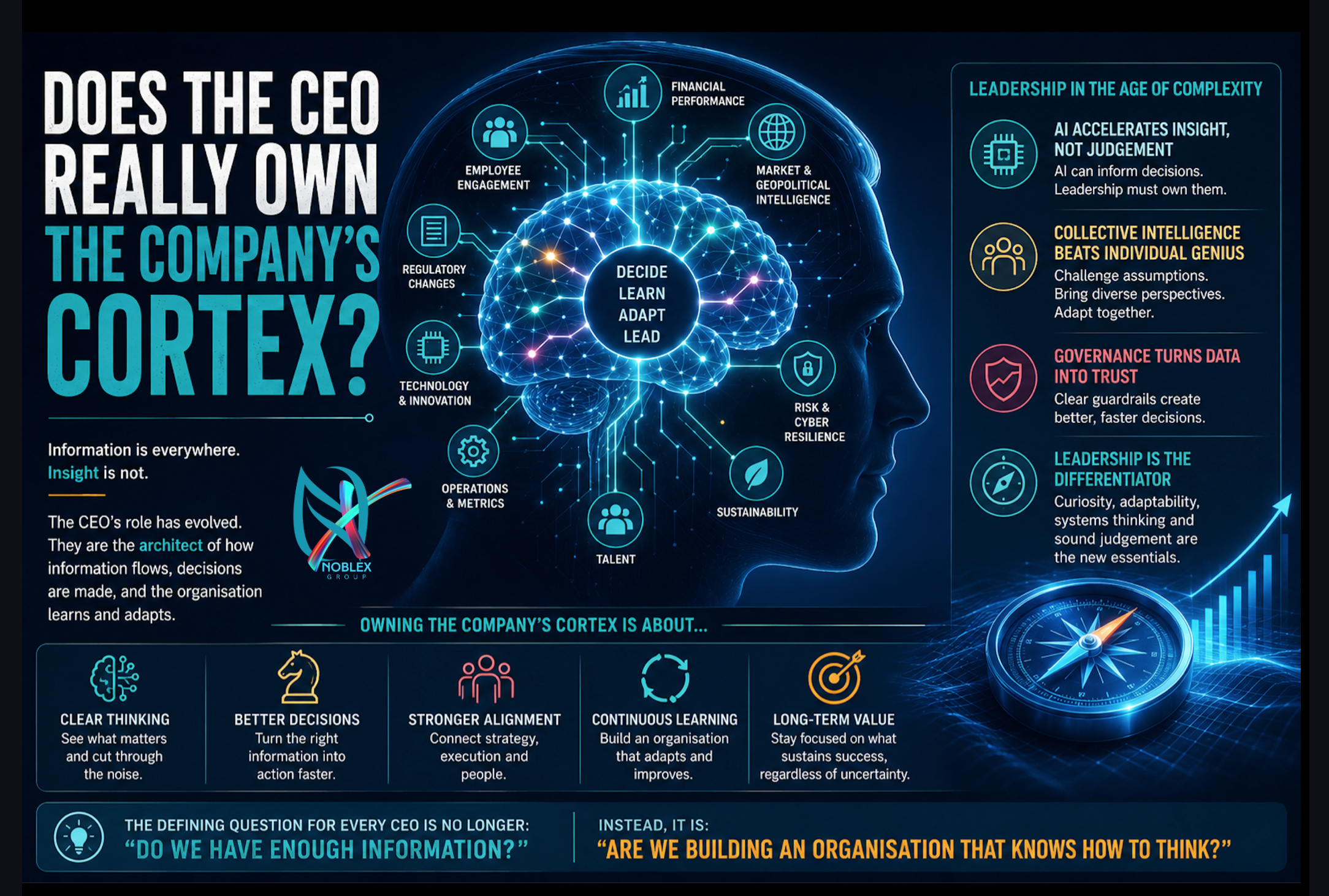
Today’s CEO agenda has never been more demanding.
Driving profitable growth. Managing rising costs. Navigating geopolitical uncertainty. Harnessing artificial intelligence. Attracting and retaining exceptional talent. Meeting sustainability commitments. Strengthening cyber resilience. Preparing for the next disruption before the current one has even passed.
The modern CEO is expected to lead across every dimension of the business simultaneously.
But amidst these competing priorities, one question is becoming increasingly important:
Does the CEO truly own the company’s cortex?
The human cortex is responsible for decision-making, reasoning, memory, learning, and problem-solving. It processes information from multiple sources before determining the most effective course of action. In many ways, an organisation’s “corporate cortex” should function in exactly the same way.
Every day, vast amounts of information flow into a business. Financial performance, customer feedback, operational metrics, market intelligence, geopolitical developments, regulatory changes, technological innovation, employee engagement, and competitive activity all compete for executive attention.
The challenge is no longer a lack of information.
It is knowing which information deserves attention and how quickly it can be transformed into better decisions.
Many organisations have invested heavily in data platforms, AI tools, dashboards, and automation. Yet technology alone does not create organisational intelligence. Without clear governance, integrated thinking, and leadership alignment, data becomes noise rather than insight.
This is where the CEO’s role has fundamentally evolved.
Today’s chief executive is no longer simply the organisation’s most senior decision-maker. They are the architect of how information flows across the business. They set the culture for decision-making, determine how quickly the organisation learns, and create the conditions for collaboration between finance, technology, operations, people, and strategy.
Artificial intelligence is accelerating this transformation.
AI can process enormous volumes of information, identify patterns, and generate recommendations in seconds. However, it cannot replace judgement, context, ethics, or accountability. Those responsibilities remain firmly with leadership.
The organisations that will thrive in the years ahead are unlikely to be those with the most sophisticated AI tools alone. They will be the ones that combine technological capability with disciplined leadership, clear governance, and a culture of continuous learning.
Equally important is the executive team itself.
No CEO possesses every answer. High-performing organisations are built by leadership teams that challenge assumptions, bring diverse perspectives, and are willing to adapt as circumstances change. A company’s collective intelligence is often far greater than the knowledge of any one individual.
From an executive search perspective, this raises an interesting shift in leadership expectations.
Boards are increasingly looking beyond technical expertise and sector experience. They want leaders who can connect strategy with execution, balance innovation with governance, interpret complex information, and lead confidently through uncertainty. Curiosity, adaptability, systems thinking, and sound judgement are becoming as valuable as traditional operational expertise.
Owning the company’s cortex is therefore not about controlling every decision.
It is about creating an organisation that thinks clearly, learns continuously, responds intelligently, and remains focused on long-term value creation regardless of external uncertainty.
In a world where technology evolves faster than ever and geopolitical events can reshape markets overnight, perhaps the defining question for every CEO is no longer, “Do we have enough information?”
Instead, it is:
“Are we building an organisation that knows how to think?”
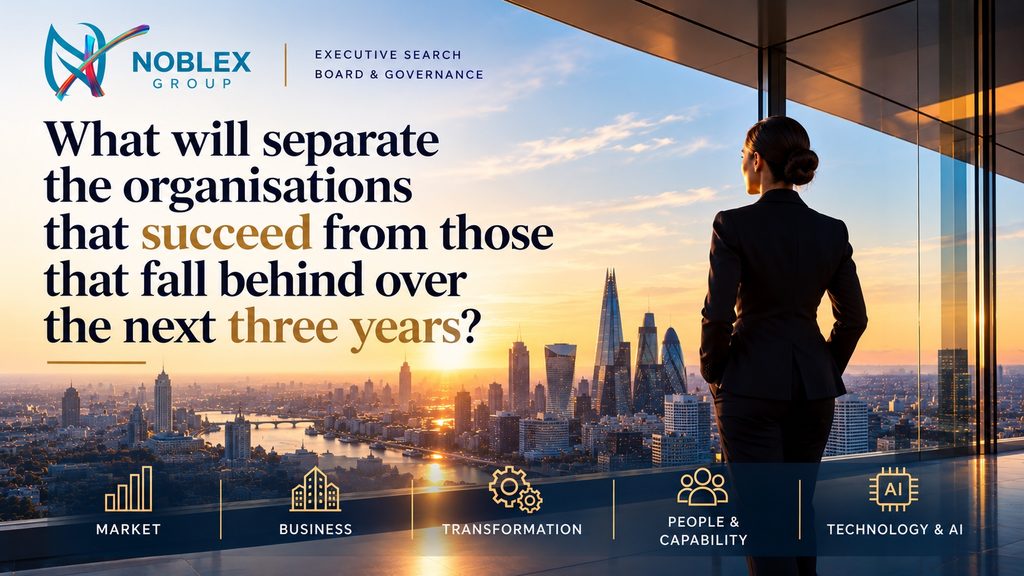
𝐖𝐡𝐚𝐭 𝐰𝐢𝐥𝐥 𝐬𝐞𝐩𝐚𝐫𝐚𝐭𝐞 𝐭𝐡𝐞 𝐨𝐫𝐠𝐚𝐧𝐢𝐬𝐚𝐭𝐢𝐨𝐧𝐬 𝐭𝐡𝐚𝐭 𝐬𝐮𝐜𝐜𝐞𝐞𝐝 𝐟𝐫𝐨𝐦 𝐭𝐡𝐨𝐬𝐞 𝐭𝐡𝐚𝐭 𝐟𝐚𝐥𝐥 𝐛𝐞𝐡𝐢𝐧𝐝 𝐨𝐯𝐞𝐫 𝐭𝐡𝐞 three 𝐲𝐞𝐚𝐫𝐬?
Strategy will remain important.
But strategy alone does not determine success.
The organisations that outperform over the next three years are likely to be those that can turn strategic ambition into consistent, disciplined execution.
That requires more than a strong business plan.
It requires the right leadership, specialist capability, transformation capacity, people and technology, – working together rather than operating as separate priorities.
At Noblex Group, we see five areas that deserve particular attention:
𝟏. 𝐌𝐚𝐫𝐤𝐞𝐭
How well does the organisation understand where its market is heading?
Customer expectations are changing. Competitive landscapes are shifting. New business models are emerging.
The question is no longer simply:
“Where are we today?”
It is:
“Where will our market be in three years, – and are we building the capability to compete there?”
𝟐. 𝐁𝐮𝐬𝐢𝐧𝐞𝐬𝐬
Growth requires more than ambition.
Organisations need leaders who can translate market opportunity into sustainable commercial performance, – while balancing growth, profitability, risk and operational resilience.
The strongest organisations will understand not only where to grow, but how to grow responsibly.
𝟑. 𝐓𝐫𝐚𝐧𝐬𝐟𝐨𝐫𝐦𝐚𝐭𝐢𝐨𝐧
Transformation has become a permanent feature of organisational life.
Digital transformation, operating-model change, regulatory requirements, restructuring and evolving customer expectations all require organisations to adapt continuously.
But transformation does not succeed because an organisation announces it.
It succeeds because leaders can mobilise people, make difficult decisions and sustain momentum when the initial enthusiasm disappears.
𝟒. 𝐏𝐞𝐨𝐩𝐥𝐞 & 𝐂𝐚𝐩𝐚𝐛𝐢𝐥𝐢𝐭𝐲
Technology can accelerate an organisation.
People determine whether it can actually use that technology effectively.
Future competitiveness will depend heavily on access to specialist expertise, leadership capability and people who can operate comfortably through uncertainty and change.
This raises an important leadership question:
Do we have the capability today that our strategy will require tomorrow?
If the answer is no, organisations need to understand the gap early, – not when the transformation is already underway.
𝟓. 𝐓𝐞𝐜𝐡𝐧𝐨𝐥𝐨𝐠𝐲 & 𝐀𝐈
AI is rapidly changing how organisations operate, make decisions and compete.
But technology itself is not a strategy.
The real differentiator will be the ability to combine technology and AI with strong leadership, appropriate governance, specialist expertise and a clear understanding of where technology creates genuine value.
The organisations that succeed will not necessarily be those that adopt the most technology.
They will be those that know where technology should be applied, – and where human judgement must remain central.
𝐓𝐡𝐞 𝐫𝐞𝐚𝐥 𝐪𝐮𝐞𝐬𝐭𝐢𝐨𝐧: 𝐡𝐨𝐰 𝐜𝐨𝐧𝐟𝐢𝐝𝐞𝐧𝐭 𝐚𝐫𝐞 𝐲𝐨𝐮?
Looking three years ahead, organisations should be asking themselves:
Market: Do we understand where our industry is going?
Business: Can we convert opportunity into sustainable growth?
Transformation: Can we execute major change successfully?
People & Capability: Do we have the leadership and specialist expertise to deliver our strategy?
Technology & AI: Are we investing in the right technology, – and have we built the governance and capability to use it responsibly?
Because ultimately, the gap between organisations that have a great strategy and organisations that actually win may come down to one thing:
𝐓𝐡𝐞𝐢𝐫 𝐚𝐛𝐢𝐥𝐢𝐭𝐲 𝐭𝐨 𝐞𝐱𝐞𝐜𝐮𝐭𝐞.
And execution is a leadership question.
At Noblex Group, we believe the quality of leadership at the top of an organisation has a direct influence on its ability to navigate complexity, manage transformation and create sustainable long-term value.
The next three years will not simply test organisations’ strategies.
They will test their leadership.